
Your brand is not your biggest problem. Most established business owners genuinely believe this. The product needs work, the team needs scaling, the sales process needs tightening. The brand? That can wait. Except it cannot, and the evidence is sitting right there in your revenue plateau.
A business growth ceiling brand problem looks nothing like a branding problem on the surface. It looks like a sales problem. A pricing problem. A leads problem. You discount when you should not have to. You win the wrong clients and lose the right ones. You explain your value in every meeting because nobody arrives already understanding it. That is not a sales failure. That is a clarity failure, and clarity lives in your brand.
The direct answer: a business hits a growth ceiling when its brand positioning strategy stops reflecting what the business has actually become. The market cannot buy what it cannot understand, and your brand is the first thing the market reads.
Why Operational Fixes Do Not Solve Brand Problems
Here is the thing most businesses do at the ceiling: they fix the wrong variable. They hire a new sales director, rebuild the CRM, refresh the website copy, run another campaign. None of it sticks, because the underlying signal the market is receiving has not changed. The brand still says something different from what the business actually delivers.
Think of it this way. If your positioning is blurred, every marketing pound you spend is fighting against itself. You are pouring water into a bucket with a crack at the bottom. According to Kantar's BrandZ research, brands with high clarity of purpose grow at more than twice the rate of those without it. That is not a soft finding. That is a structural business advantage being left on the table.
The operational fixes are not wrong. They are just downstream of the real problem. Sort the brand first, and everything else gets easier.
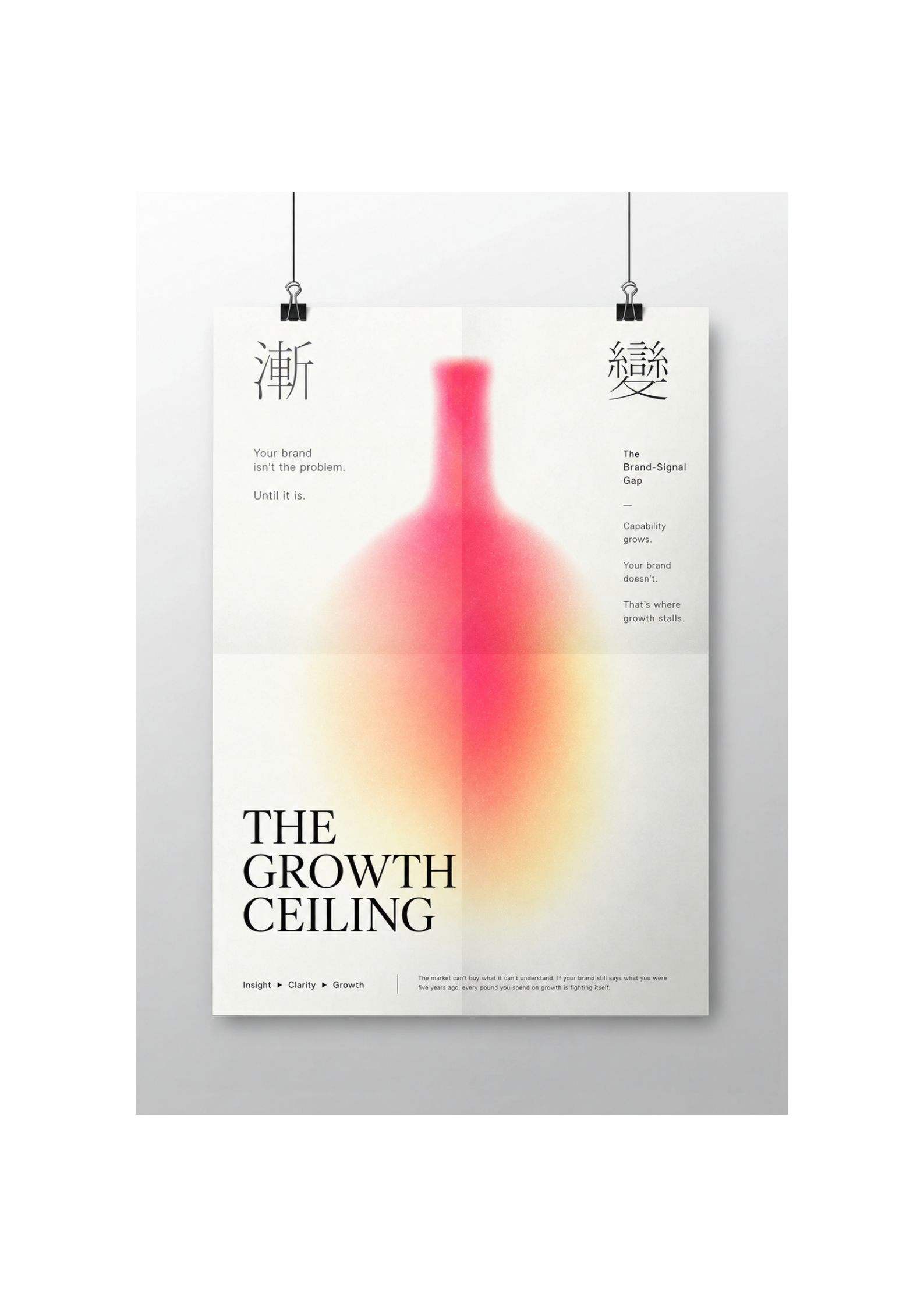
Introducing the Brand-Signal Gap
There is a concept worth naming here: the Brand-Signal Gap. It is the distance between what your business has become operationally and what your brand communicates to the outside world. Every serious business develops one over time, usually without noticing.
You started with a lean brand built for early momentum. It got you to revenue. It got you to a real team, real clients, real capability. But the brand never evolved with you. So now you have a premium service wearing a mid-range costume. Your proposals say one thing, your website says another, your LinkedIn presence says you launched last Tuesday. The market, which is making fast judgements, reads the lowest signal in the room.
The Brand-Signal Gap is not a creative problem. It is a business positioning problem. And it compounds. Every month you operate with a gap between what you are and what your brand says you are, you are subsidising your competitors' growth with your own credibility.
What the Sharp End of the Industry Is Already Doing
This is not where things are heading. This is where the sharp end already is.
The most commercially sophisticated businesses treat their brand strategy framework the way they treat their financial model: as a living document that gets reviewed, stress-tested, and updated as the business grows. They are not refreshing their logo every two years. They are interrogating their positioning. Who are we now? Who is the competition now? What does our ideal client believe before they find us, and what do we need them to believe after?
The businesses that break through growth ceilings consistently are the ones that recognise brand positioning strategy as infrastructure, not aesthetics. They commission brand strategy work with the same rigour they apply to a market entry decision or a hiring plan. If you want to see what that looks like in practice, the Nafas brand strategy project is a clean example of a business using clarity as the engine of a growth repositioning, not decoration on top of it.
The Cost Calculation Most Businesses Get Wrong
When businesses consider working with a brand strategy consultant UK, the conversation almost always starts with cost. What does this actually cost? That is not a bad question. It is just the wrong starting point.
The right question is: what is the Brand-Signal Gap currently costing you? If you are discounting to close deals you should be winning at full price, run that number annually. If you are losing pitches to competitors with weaker capabilities but stronger presence, what is the revenue value of those losses? If your best prospective clients cannot immediately grasp why you are the right choice, how many of them are simply not coming back?
Brand strategy cost UK varies depending on scope, but the investment in a serious brand strategy engagement is almost always smaller than the ongoing cost of a gap the business has been quietly absorbing for years. We have written a transparent breakdown of what brand strategy actually costs if you want specifics without the sales pitch.
The uncomfortable truth is this: the businesses most resistant to investing in brand strategy are usually the ones who need it most, because the confusion that lives in their brand has already made its way into how they think about their own value.
What Clarity Actually Unlocks
Clarity is not a brand virtue. It is a commercial one.
When your brand positioning strategy is precise, your sales process shortens because the right clients arrive pre-convinced. Your pricing holds because the market understands what it is paying for. Your team recruits more easily because people want to join something with a clear identity. Your marketing compounds because every channel is reinforcing the same signal instead of muddying it.
• Research from Edelman consistently shows that trust is the primary driver of business decisions at every level of the buying process. Trust is built through coherence: coherence between what you say, what you look like, and what you deliver. A blurred brand breaks that coherence before the conversation even starts.
If you are not sure whether you have a Brand-Signal Gap, there are seven specific signs your brand has not kept pace with your business growth that are worth reading. Most businesses recognise themselves in at least four of them.
The Uncomfortable Truth About Waiting
Every quarter you operate with a Brand-Signal Gap is a quarter your competitors benefit from your ambiguity. The clients who could not immediately tell why you were the right choice went somewhere else. The partnership that never materialised did so because the first impression did not hold up. The talent who chose the competitor probably did it because that brand felt like somewhere they could be proud to work.
None of this shows up in a specific line on a P&L. That is exactly why it persists. The cost of brand confusion is diffuse, invisible, and cumulative. And it is the most expensive thing most established businesses are not measuring.
The ceiling is real. The bottleneck is identifiable. And unlike most growth constraints, this one can be resolved with a clear-headed piece of strategic work rather than years of operational slog. If you want to understand the full mechanics of how brand clarity drives commercial growth, the complete guide to brand clarity for growing businesses is the right place to start.
The question is not whether your brand is holding you back. The question is how much longer you are willing to let it.
If the ceiling feels familiar but you have not been able to name exactly why it is there, that is usually the first sign it is a brand problem in disguise. At ruko.studio we work with established businesses to close the gap between what they have built and how the market sees them. Give us a shout and let us show you where the gap is.
